Currently on view at 17 Savile Row, W1S, Lord Arthur Savile’s Crime is a major exhibition in London running from January 21st to March 21st, 2026. Presented as a group show in the newly opened Sadie Coles HQ space on Savile Row, the exhibition draws its conceptual framework from Oscar Wilde’s darkly comic novella of the same name, written in London in 1891.
Inspired by Wilde’s sharply observed portrait of Victorian society, the exhibition translates literary satire into a visual language that spans multiple generations, scales and media. Set in a building originally constructed in 1870 as an arts club, the exhibition reactivates the historic function of the space — once a site for salons, society gatherings and intimate displays — and places it in dialogue with contemporary artistic practice.
A Wildean lens on social performance
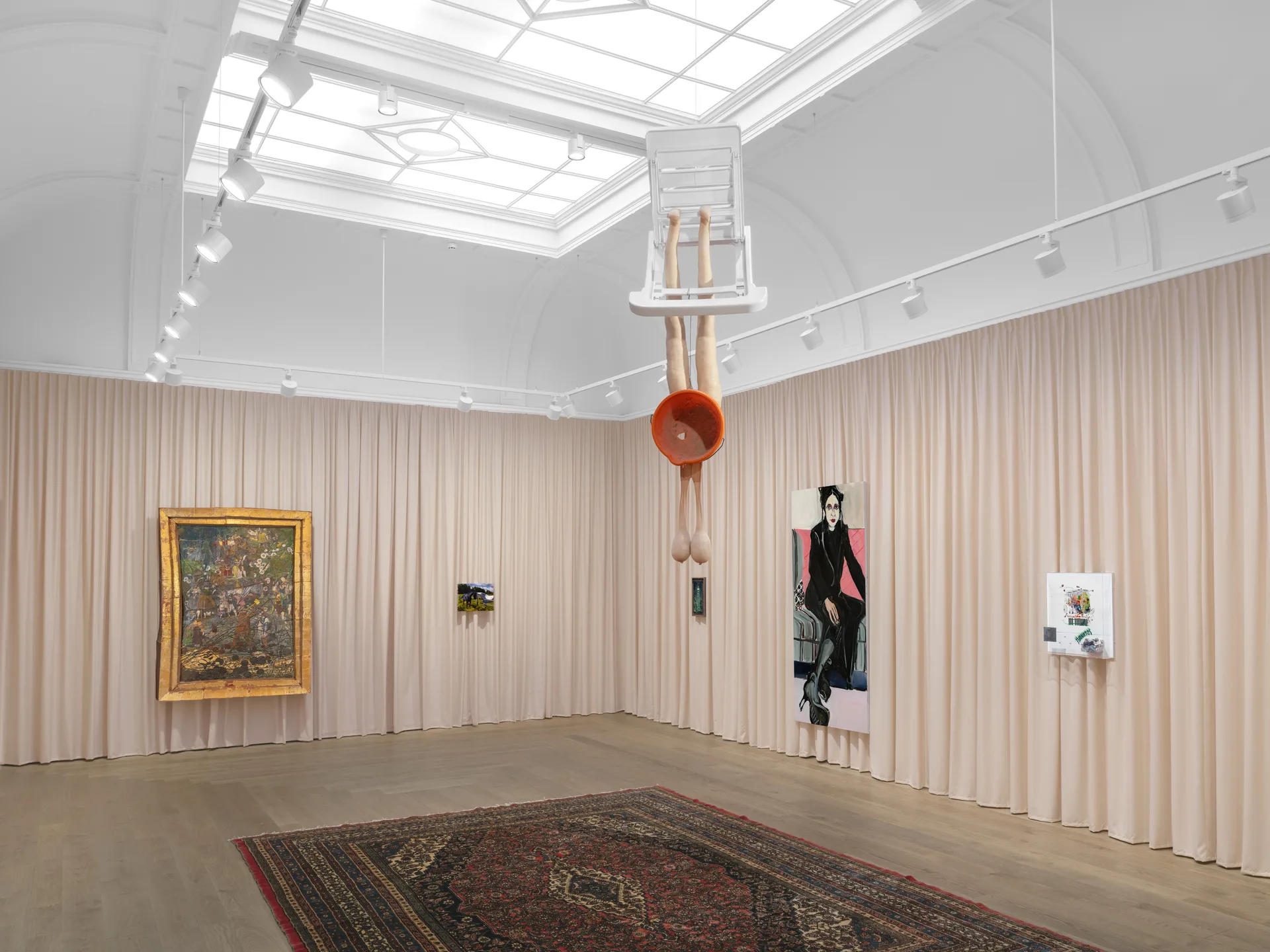
At its core, Lord Arthur Savile’s Crime explores themes of performative behaviour, morality and social theatre. Populated by palm readers, ornamental curiosities and melodramatic codes of honour, Wilde’s story provides artists with a lens through which to examine how identity is staged, judged and consumed in both the nineteenth century and the present day. The scenography of the exhibition echoes a maximalist, salon-style aesthetic, heightening the sense of narrative drama and social observation.
Works between satire and suspense
Across painting, sculpture and installation, the exhibition brings together an expansive, multigenerational group of artists whose practices probe the tension between performance, psychology and social ritual. Works by figures such as Cecily Brown, John Currin and Elizabeth Peyton revisit the language of portraiture and intimacy, exposing desire, vulnerability and the theatrical construction of identity. Artists including Nicole Eisenman, Sarah Lucas and Tala Madani approach the body with biting humour and distortion, echoing Wilde’s satirical dismantling of moral seriousness and social pretence.
Elsewhere, painters such as Lisa Brice, Chantal Joffe and Celia Paul explore interiority and self-presentation through charged figuration, while artists like Monster Chetwynd and Anthea Hamilton introduce elements of masquerade, excess and performative absurdity. Sculptural and conceptual gestures by Urs Fischer, Helen Marten and Laura Owens further destabilise the boundary between luxury and threat, surface and subtext — recalling Wilde’s fascination with decorative objects that conceal danger beneath polished exteriors.