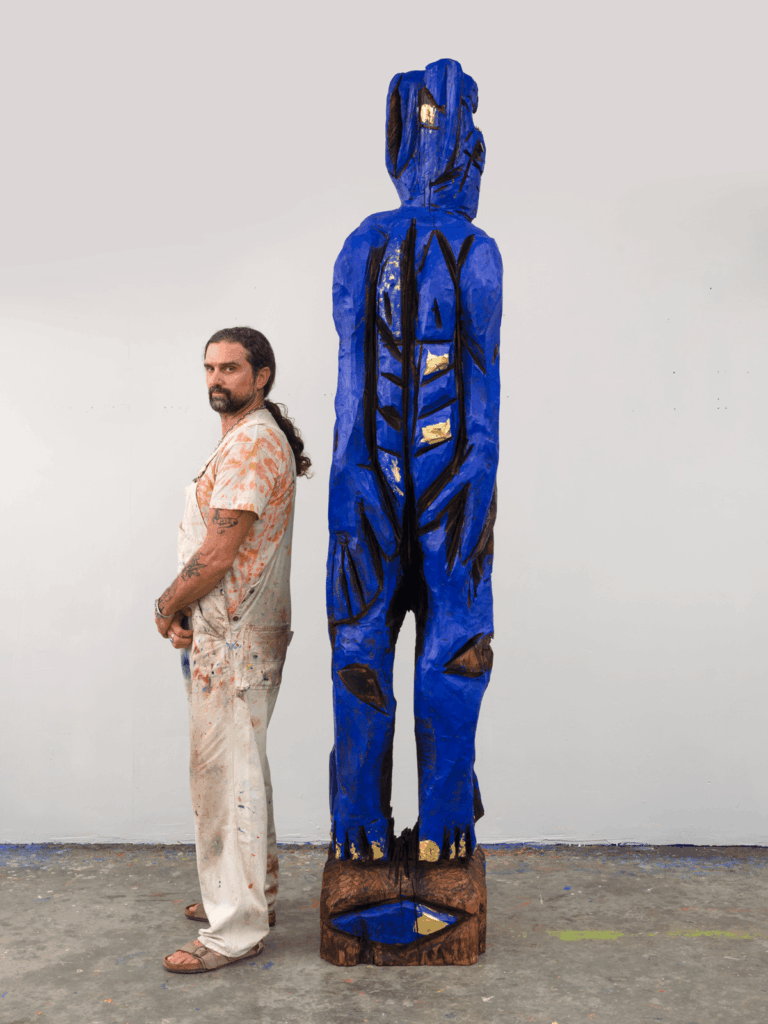
Photography by JEFF MCLANE
Image courtesy of RYAN SCHNEIDER and ALMINE RECH
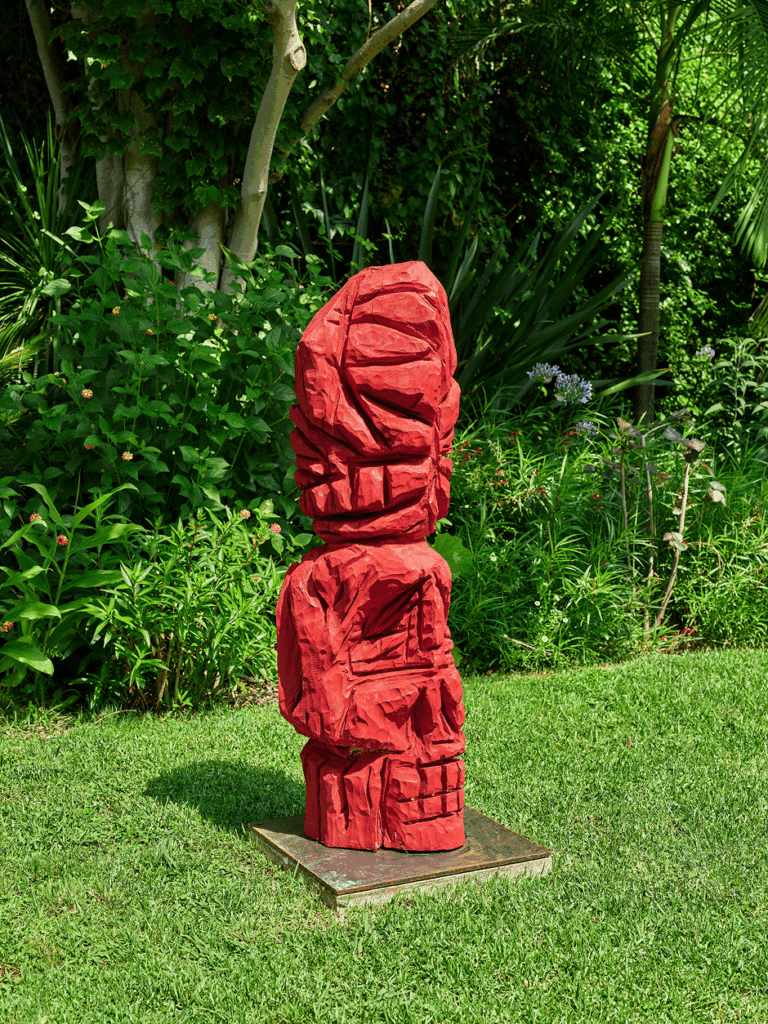
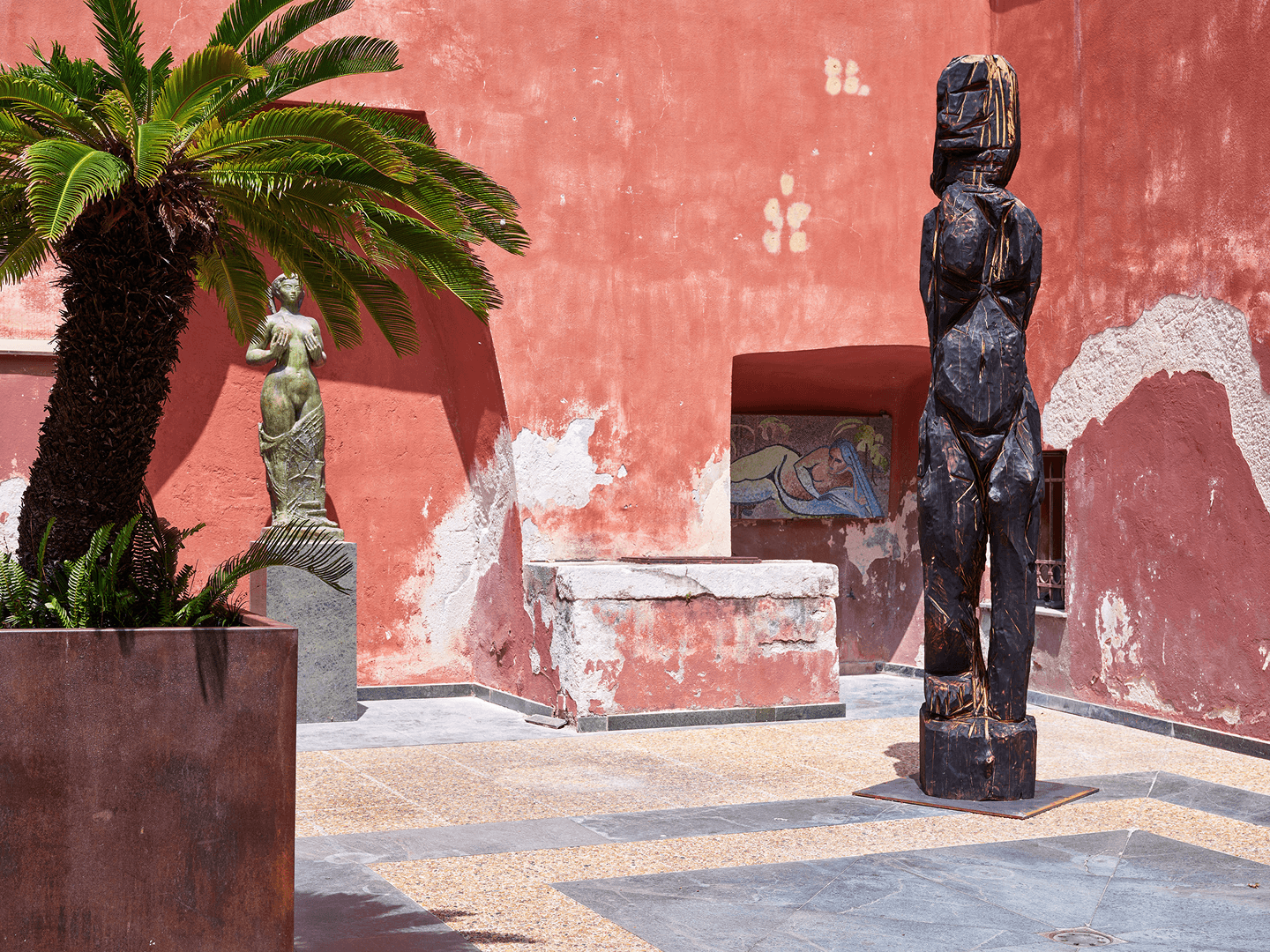
Death No Disaster, 2025
© RYAN SCHNEIDER
Courtesy of RYAN SCHNEIDER, LA CITADELLE and ALMINE RECH
Photography by JEAN-CHRISTOPHE LETT
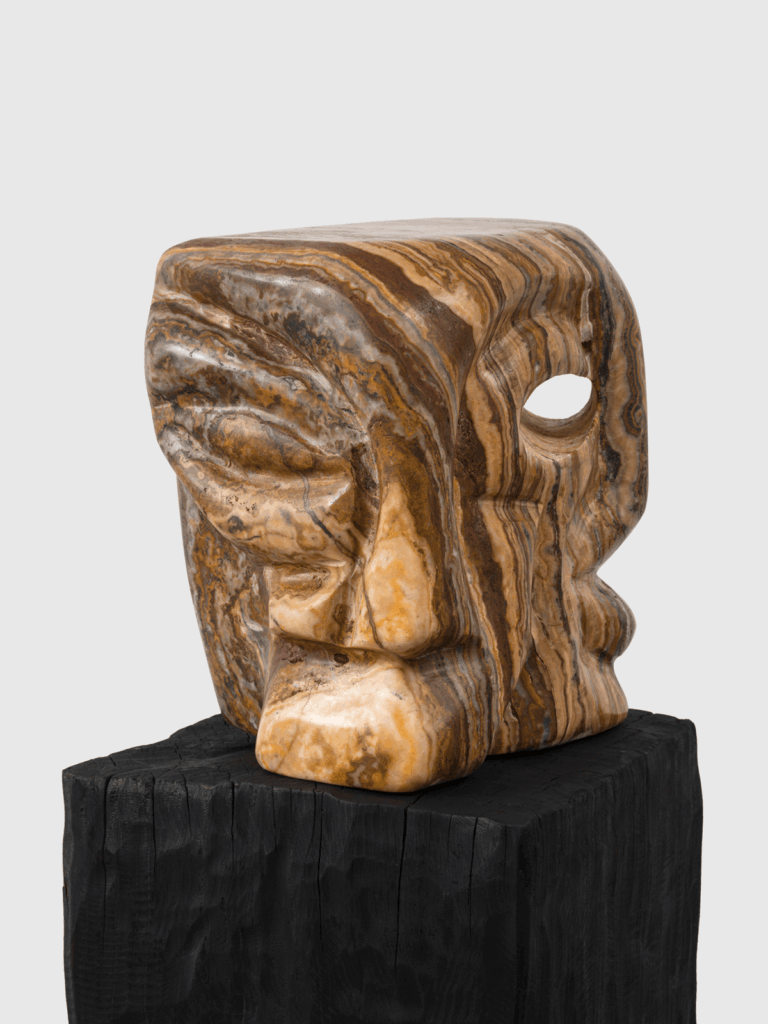
Chaos Helmet, 2025 © RYAN SCHNEIDER
Courtesy of RYAN SCHNEIDER and ALMINE RECH , photography by JEFF MCLANE
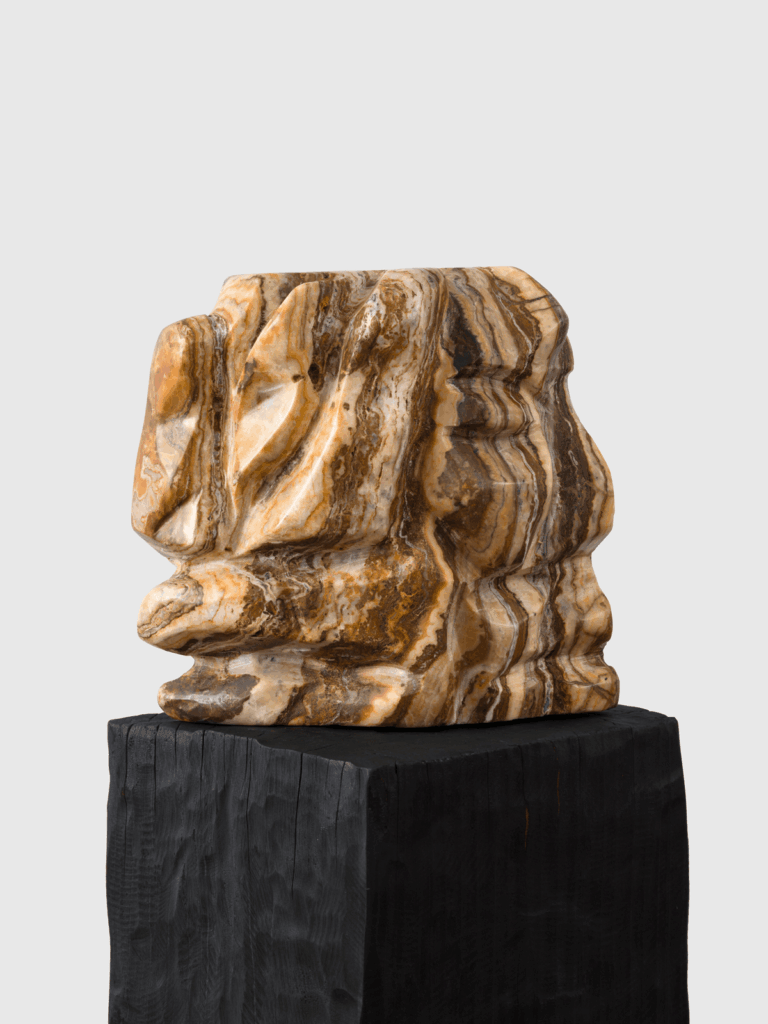
Inner Witness, 2025 © RYAN SCHNEIDER
Courtesy of RYAN SCHNEIDER and ALMINE RECH, photography by JEFF MCLANE
What does it mean to abandon the surface, not simply to leave painting behind, but to relinquish the very fiction of control it facilitates? For American painter-turned-sculptor Ryan Schneider, it hasn’t been a transition in the progressive sense, but a palpable rupture: a movement away from colour and composition toward material and matter itself. Ahead of his forthcoming exhibition Murmuración, at La Térmica, Málaga, June 4th – September 13th, 2026 (in collaboration with Alicia Gutiérrez Mármol, of Mármol and Fa, and Almine Rech Gallery), talk about the significance of his move away from painting to sculpture. Explaining how the works are not born of any single idea, but through exposure to wood and marble, learning their indentations, resistance, and identity through physical contact. In the process, circling material, hanging over it, pushing against it as much as yielding to it, before finally finding a vulnerable spot to puncture into, to mark the surface and make his presence felt. “I always start by asking the material what it wants to be,” he says, an act that relinquishes authorship for a greater uncertainty.
Painting carries doubt and deals in revision, sculpture doesn’t, it insists on consequence. As the late American sculptor Richard Serra wrote as part of his Verb List (1967–1968), “to lift, to prop, to balance” are not simply gestures but acts of physical consequence that require of the artist complete bodily engagement. Schneider’s works unfold within this field of risk, where every cut commits the body and binds the form. Exhausting himself until the material has successfully metamorphosed into a new entity, there is, as he explains, no reversal, no erasure, only the momentum of movement. “The material will only let you do what you can do to it.” The work is not planned in the way of a painting. These materials are cradled, committed to, creating their own dust and dirt that burn and bury themselves into the artist’s hands, as their substance manifests into a new version of itself; and it is the body that battles for that incarnation. The final form is born from a sustained period of performative action, not intended for an audience, neither designed to accompany the work, but absorbed into its surface, as Schneider’s energies are expelled into the body and bones of the sculpture. To come close to one of his works is to encounter such effort, an endeavour to craft something from raw matter in a manner that makes it feel entirely otherworldly. “It’s like a physical trip… spiritual, psychological.” This is sculpture as ordeal, and as evidence of self as action. As turn-of-the-century French philosopher Maurice Merleau-Ponty insisted, the body is not in space, it is of it; perception is already entangled with movement. Schneider’s forms emerge from that entanglement, where thinking happens through action, and action leaves its trace as form.
But what unfolds is closer to choreography than creation. “There is a dance to it.” The statement is deceptively simple. This is not metaphor but method. Chainsaw as an extension of his hand, Schneider enters a field of forces where balance is provisional, and the possibility of failure ever-present. In the terms of French philosopher Gilles Deleuze, Schneider is not executing a form but tracing a “line of flight,” a movement that escapes fixed form and gradually pushes him toward sculpture itself. In that sense, the sculpture does not pre-exist the act; it emerges from it. And that level of physical engagement recalls the late German dancer and choreographer Pina Bausch, who insisted, “I am not interested in how people move, but in what moves them,” a distinction that resonates with Schneider’s concern for movement not as technique, but as necessity, compulsion, and a response to the pressure of matter itself. And yet this emergence is far from harmonious; for the artist it is unstable, unforgiving, and even violent. “It’s all mistakes… all trial and error.” Here, the work aligns less with classical sculpture than with what French philosopher Georges Bataille termed l’informe, a condition in which form is not elevated, but undone, brought back into contact with base matter. Schneider’s sculptures hover between intention and accident, between what exists within the material and what we wish of it. That slippage isn’t corrected but positively preserved. “Sometimes that’s the thing that’s holding it all together.”
This refusal of resolution unsettles the idea of completion and sculptural completeness. Works are returned to, stripped back, rediscovered, and reworked, and what once appeared unresolved becomes, with time, necessary. The work does not stabilise, it metamorphoses, and in that sense, Schneider extends a lineage that includes Constantin Brâncuși and Isamu Noguchi, for whom material was never passive, but problematic, proving far more than its surface appearance. But where Brâncuși sought essence, and Noguchi equilibrium, Schneider pushes toward friction, toward a state in which material resists resolution and insists on its own agency. And yet, something remains. Unlike dance, which disappears in the instant of its execution, Schneider’s work leaves behind a residue of itself, a form that holds the essence and energy of its making, as he explains: “It’s like a memento… a physical residue.” What we encounter is not the act, but its aftermath, a compression of time, labour, and risk into matter. The audience arrives after the event, yet still feels its force. To look at a work is to reimagine what can no longer be seen: the violent breath of the chainsaw, the arc of his heavy arms, the torque of the body, the anticipation and final execution of the cut, leading to a frenzy of marks that appear as countless wounds across the material’s surface. Sculpture becomes a deferred action, a choreography stilled but not resolved. And as American art critic Rosalind Krauss suggested in her notion of the “expanded field,” sculpture here exceeds objecthood, operating between action and perception. Schneider occupies that unstable threshold, where making is not representation, but event. This is not the translation of movement into form, it is material under pressure, movement that has hardened into matter without ever relinquishing the possibility of collapse.
Rajesh Punj: You mentioned earlier that you had to use a forklift to move the work, and that you’d been working on it intensively for hours. It sounds like one of the most demanding pieces you’ve undertaken. Remind me, the wood itself, what is it?
Ryan Schneider: It’s called Sapele, S-A-P-E-L-E.
RP: Not a wood I was familiar with. You said it’s from the Congo in Africa. How did it come about that you’re working with it here?
RS: The people who organised the exhibition found it for me. I don’t know exactly how or why, but they sourced it in Portugal. So, I don’t really know how it made its way from Africa to Portugal, but that’s where it came from. What I’m discovering here is that people actually know this wood. It’s considered very special, exceptional to work with. Yesterday someone from the museum brought a local woodcarver to the studio. He makes these incredible carved spoons. When I told him it was Sapele, he just stopped, like it was something mystical. He told me that in parts of Africa it’s considered one of the most important, almost magical woods, a very spiritual tree. He said it’s an honour to work with it. And I already felt that. When I first saw the log, I had no idea it would be that big. I thought, this is crazy. It’s not something I would normally attempt, because it’s so hard to work with, almost impossible, because I can’t easily move it.
RP: Because it’s important for you to be able to move around the work?
RS: Exactly. I need to be able to move it, and move around it, to access different areas. But even with that, I could feel immediately how special the log was. When I started working on it, I was doing what I always do, asking the material what it wants to be, not trying to impose too much intention on it.
RP: Letting it guide you?
RS: Yes, going with what it wants to be. It’s become this daily labour. I’m really excited about how it’s going so far. Today we used a forklift to turn it so I could work on the other side. I’ve been working on it all day; my muscles are kind of on fire.
RP: You must be exhausted.
RS: It’s a good feeling. The physicality is a big part of my work. Using my body is a really important element.
RP: You mentioned before that you injured your left hand, how are your fingers now?
RS: They’re good now, but I didn’t work for about five months. I made a couple of stone sculptures, but for the most part I wasn’t working. My body lost muscle mass. If I’m not using my body in this way, I get depressed.
RP: Does it leave you feeling ungrounded?
RS: Yes, disoriented. So being here, working on this huge Sapele tree, is a real gift. It’s reawakened my body, my muscles. It’s healing, in a way.
RP: It feels like you’re pushing yourself over consecutive days, almost to exhaustion. Do you know your limits, or do you go beyond them to reach something, to arrive at a conclusion in the work?
RS: I’m always pushing the limit of what I can do. There are a couple of sides to it. One is the physical side, the material and how you work with it. Each material requires a different physical action. Working stone is completely different from using a chainsaw on wood. And the material will only let you do what you can do with the tools you’re using. With something like this, using a chainsaw on a piece of wood that’s huge and hard to move, I’m climbing on top of it. I can only do what the chainsaw allows me to do. The other aspect is that the movement of my body, the tool, and the resistance of the material all help shape the form.
RP: So, the form emerges through that resistance?
RS: Exactly. When I’m really in it, I’m in this kind of flow. I’m not really thinking, I’m just moving and cutting. It’s almost like a trance. The work is about many things, but in the act of sculpting, it’s very immediate. Your body just knows what to do, like yoga. There’s a connection between my hands, arms, legs, the chainsaw, and the wood, or the grinder and the stone. I have to move my body in all kinds of ways to get the cuts and the form. It’s a very physical practice, and it pushes my body to all kinds of limits.
RP: And when you reach those limits, after something like the Citadel exhibition in France, what remains?
RS: After that show, I was completely depleted. It was the most work I’d ever made, the hardest I’d ever worked. The biggest show I’d done. Going back to California, I was kind of a zombie. And then I made another show straight after. I didn’t know how I was going to do it; I was exhausted. It felt like working on the fumes of fumes. But there’s something in that. I couldn’t overthink it. I couldn’t question it too much. I just had to do what I could do physically, and that shaped the work. I’m really proud of how that show turned out, it carries that exhaustion.
RP: It feels, when I see the work, that you leave something of yourself in it, that there’s a kind of transfer, almost. As if something of you remains behind.
RS: Yeah, I think that’s true. That whole period was intense. After that show, and then breaking my fingers, I couldn’t hold a tool for months. I eased back in slowly, made a couple of sculptures, and then came here. As soon as I saw that tree, I just thought, okay, let’s do this. It’s brought me back to life, in a lot of ways. I feel clear, grounded, awake again.
RP: When you’re working with a material that carries that kind of weight, physical, but also cultural, even spiritual, do you feel there’s no room for error? Or is it still a process of trial and adjustment?
RS: It’s all mistakes. It’s all trial and error. That’s how I’ve always worked, even when I was painting. I used to look a lot at Willem de Kooning, his paintings are like excavations. Adding, subtracting, adding, subtracting. The layers are what make them luminous. That’s always been my attitude. If I have an idea or an intuition, I must try it. It doesn’t always work. It doesn’t always look good. And sculpture is the same. I can’t be afraid to mess up.
RP: But with sculpture, once you remove material, you can’t bring it back.
RS: Exactly, you just have to adjust. I might have a sense of what something could be, looking at a piece of wood or stone for days or weeks. But I don’t do preparatory drawings or anything like that. Once I start working, I have to respond to what’s happening. There’s intention, but there’s also openness, to the reality of the moment.

Deities Ascending, 2025 © RYAN SCHNEIDER
Courtesy of RYAN SCHNEIDER and ALMINE RECH, photography by MELISSA CASTRO DUARTE

Chaos Helmet, 2025 © RYAN SCHNEIDER
Courtesy of RYAN SCHNEIDER and ALMINE RECH , photography by JEFF MCLANE

Chaos Helmet, 2025 © RYAN SCHNEIDER
Courtesy of RYAN SCHNEIDER and ALMINE RECH , photography by JEFF MCLANE

Owl Children, 2025 © RYAN SCHNEIDER
Courtesy of RYAN SCHNEIDER and ALMINE RECH, photography by MELISSA CASTRO DUARTE

Janus, 2025 © RYAN SCHNEIDER
Courtesy of RYAN SCHNEIDER and ALMINE RECH, photography by JEFF MCLANE

At Rest in the Void I, 2025 © RYAN SCHNEIDER
Courtesy of RYAN SCHNEIDER and ALMINE RECH, photography by JEFF MCLANE
RP: So, it becomes a kind of collaboration?
RS: Yeah, a collaboration, a confrontation, a negotiation. That’s a really important part of my work. I’m not looking at a tree or a block of stone and thinking, I know exactly what this will be. It’s more about being open, being humbled by it. I work very hands-on; I touch everything I make. Even when I’m about to work with a robot in Italy to carve marble, I’ll still do the finishing myself. I have to respond to the physical reality of the piece. Sometimes it feels like a kind of channelling, like my body is just doing things, and the form is emerging in that moment. Then I step back, pause, come back to it, and make more intentional decisions. It’s both instinct and reflection.
RP: And the materials themselves, they carry their own histories.
RS: Yeah, absolutely. Wood was once alive, it grew somewhere, it had a life. I only work with wood that’s been cut because it was diseased or fell naturally. So, there’s already an energy there. And with stone, it’s incredible. You’re working with something that’s been in the ground for hundreds of thousands of years. The onyx I use is formed through layers of sediment, compressed over time, with chemical reactions creating quartz and crystals. There’s a real earth energy in that. My studio in California is outdoors, surrounded by ancient rock formations and trees. So that sense of life, earth life, is always present in the work.
RP: So unlike painting, you’re not beginning from nothing.
RS: Exactly. It’s not a blank canvas. These materials already have history, identity, life. You’re entering into that. And in a way, it connects to something very fundamental. Any ancient culture, people carving stone, making marks, they were doing the same thing. Taking material and figuring it out as they go. That’s one of the most human acts there is. You can put a Neolithic carving next to a modern sculpture, the basic forms aren’t so different. I don’t see a hierarchy there.
RP: We spoke before about colour, how it enters the work.
RS: Yeah. Years ago, I would have said I was a colourist. My paintings were incredibly bright, almost noxiously so. When I started making sculpture, I was really just making objects I could paint on, like three-dimensional paintings. But over time, especially after making my first bronze, I started to see something else. The form itself, the texture, the surface, that’s where the real power of sculpture is. So, I began to pull back from colour. Leaving wood raw, or burning it black, or using gold leaf. Letting the form come forward. I’m still interested in colour, but more in a controlled way, sometimes monochrome. That was something I never understood as a painter. But now I see how powerful it can be, an object that’s one solid colour, quiet and loud at the same time.
RP: You were speaking earlier about colour, how it enters the work. I’m thinking of your time at the Citadel, and your references to artists from the French Riviera. Matisse, for example, and of course Yves Klein.
RS: Yeah, exactly. I was thinking a lot about that, Matisse’s blue, Yves Klein Blue. I just tried it. That monochrome blue has something very calm about it. It doesn’t scream at you to look at it, it just quietly tracks your eye. These days, if I’m using colour, it’s mostly blue or red. Mostly blue, with a little bit of red. And then when I started working in stone, that changed things again. The colour is already there, you’re not adding it, you’re finding it, bringing it out. When you polish the surface, these incredible colours emerge from the material itself. There’s no alteration, you’re just revealing what’s already there.
RP: So, when you apply colour to wood, does it feel like a final act? A kind of resolution, the moment where the work completes its transformation from material into sculpture?
RS: That’s a good question. I don’t really have rules. I never try to recreate something I’ve done before. For me, it’s about making the form, making the object first. And then it becomes a question of how it wants to be resolved. How do I finish it? Sometimes that’s colour. Sometimes it’s letting the wood remain as it is. Sometimes it’s burning it black, or burning it and then adding gold leaf. It really depends on the piece.
RP: And can you return to a work after that point? Reopen it, intervene again?
RS: Oh, for sure. It’s never really finished until it leaves the studio. If something isn’t right, if I look at it and think, this shouldn’t be blue, I’ll take the paint off, rework it.
RP: But that moment of knowing, when it’s complete, when it’s ready to leave you, how do you recognise that?
RS: I’ve been thinking about that a lot. It’s strange. I’ll walk into a show of my own work and feel like I didn’t make it. Like I’m looking at what someone else did. I’m attached to the process, but once the work leaves the studio, once it’s in a gallery or a space, it’s not really mine anymore. I don’t walk through a show and think, I should have done more to that one. I let it go. I’m already thinking about the next thing, what I’m going to do next.

At Rest in the Void I, 2025 © RYAN SCHNEIDER
Courtesy of RYAN SCHNEIDER and ALMINE RECH, photography by JEFF MCLANE
RP: So, the work closes, and your attention moves forward.
RS: Exactly. And something else I’ve been thinking about, those moments you asked about earlier, when something doesn’t work. Back in my studio in California, I have a lot of material. If something isn’t right, if I’ve taken too much off, or it just doesn’t feel good, I’ll put it aside. Sometimes I even finish it, paint it, and still don’t like it. So, it goes into a pile. People come to the studio and want to dig through that pile. I usually feel a bit embarrassed. But lately I’ve been going back to those pieces, those unresolved works, and seeing them differently. Seeing something in their incompleteness. Their awkwardness.
RP: That sense of awkwardness, it becomes beautiful.
RS: Yeah. Sometimes that’s the whole thing that’s holding it together. That awkwardness, it feels alive. It feels real. And now I can see something in those works that I couldn’t see when I made them. The person I am now can recognise their potential in a way I couldn’t then. So, I’ve been thinking a lot about that, about how something doesn’t have to be fully resolved to be meaningful.
RP: It’s interesting, because we often think of balance as something necessary. But perhaps it can also be limiting.
RS: Yeah. I think I’ve been guilty of always seeking balance in my work. And that can become stale. Of course, with sculpture, there’s always a need for physical balance. But visual balance, that’s something I’m less concerned with now.
RP: Do you feel yourself letting go?
RS: I think so. My path has been a bit different. I spent my whole life as a painter, I started when I was twelve, and I did it every day. I only started making sculpture seven years ago. Looking back, I can see I was always trying to make sculpture in my paintings, trying to create objects. So, when I came to sculpture, I came in blind, using my instincts from painting. And now, after working every day for seven years, apart from the break when I broke my hand, I’m starting to feel more confident with the materials. More comfortable making something that exists in space, something that doesn’t need to be perfectly balanced or composed like a painting.
RP: So, the work becomes less about composition, and more about presence.
RS: Exactly. It’s still about imposing something, I mean, I’m holding a chainsaw, using my body to shape the material. But at the same time, I’m letting the material impose itself on me. I’m more intuitive now. And to be honest, I don’t feel like I have as much to prove anymore. At least to myself. So, I don’t need everything to be perfectly resolved. I can let it be what it is.
RP: Which perhaps is where a language begins to emerge.
RS: Yeah, I think so. I just turned forty-six. I’ve put in a lot of time, a lot of energy, physically, mentally. And now I feel like I know what to do, instinctively. I’m less concerned about whether people will love the work, or respond to it in a certain way. What matters more is the experience of making it, and whether the object itself feels resolved in its own way.
RP: And yet there’s still something deeply performative in what you do, something that the audience never fully sees. We encounter the work at the end, but not the process: the exhaustion, the movement, the physical negotiation. What we see is almost the trace of that action, the ghost of it.
RS: Yeah, exactly.
RP: There is something deeply performative in what you do, but the audience only encounters the final object. We don’t see the exhaustion, the movement, the body circling, climbing, cutting. We see the trace of it, the ghost of the action.
RS: Yes. For me, the making of the work is such a specific experience. At the end there is this object, this memento left behind, but the making itself is like a physical trip. And not just physical, it’s spiritual, psychological. It’s like rock climbing. To climb, you have to make these very specific moves, and you learn by doing them. It’s the same with my work. The moves I make, the physical things I do, the way I move around the object, it can feel like yoga, sometimes like dancing, sometimes just like pure movement. It’s a really special thing. I feel grateful that this is how I get to make my work.
RP: And yet that act is both private and, increasingly, public, through videos, or even people watching you work.
RS: Yes, it’s private, but it’s also public because I share videos. And right now, working on this huge log, I’m set up near these big windows. Kids sit there during lunch or while studying, and they watch me work. I’ll be doing my thing, moving around, almost dancing, and then I look up and there are people staring, taking videos, smiling, like, what is this guy doing? It’s funny. I don’t always love being watched, but it’s okay. And it’s an important part of the work.
RP: You use the word “dancing,” and I think it’s such a strong way of describing how you make the work. There really is a dance to it.
RS: There definitely is. I’m usually listening to music, and sometimes literally dancing.

Majestic & Totally Wrecked, 2025 © RYAN SCHNEIDER
Courtesy of RYAN SCHNEIDER and ALMINE RECH, photography by JEFF MCLANE

Majestic & Totally Wrecked, 2025 © RYAN SCHNEIDER
Courtesy of RYAN SCHNEIDER and ALMINE RECH, photography by JEFF MCLANE

Majestic & Totally Wrecked, 2025 © RYAN SCHNEIDER
Courtesy of RYAN SCHNEIDER and ALMINE RECH, photography by JEFF MCLANE

Last Human Teachers I, 2025 © RYAN SCHNEIDER
Courtesy of RYAN SCHNEIDER and ALMINE RECH, photography by JEFF MCLANE

Last Human Teachers V, 2025 © RYAN SCHNEIDER
Courtesy of RYAN SCHNEIDER and ALMINE RECH, photography by JEFF MCLANE

All One Or None, 2025 © RYAN SCHNEIDER
Courtesy of RYAN SCHNEIDER and ALMINE RECH, photography by JEFF MCLANE

All One Or None, 2025 © RYAN SCHNEIDER
Courtesy of RYAN SCHNEIDER and ALMINE RECH, photography by JEFF MCLANE
RP: So, you listen to music while you work?
RS: Yes, through headphones. And I’ve also become friends with a choreographer whose work I really admire, Ryan Heffington. I’ve been mesmerised by dance lately. Looking at what he does, showing people how to move their bodies, it feels so pure and exciting. You don’t need anything else. You just need to be in a body. I don’t know anything about dance in any formal way. I just know how it feels to watch it. But when I’m making sculpture, there is a dance to it: moving my feet, my torso, my arms. The sculpture is essentially a record of those movements.
RP: That’s what interests me, the difference between dance and sculpture. After a performance, there is often no physical evidence left. But with your work, the object remains as evidence of that movement.
RS: Exactly. And that connects to painting too. De Kooning was one of the artists I looked at when I was learning how to paint. He would only paint as far as his arm could reach, and in some paintings there’s raw canvas left at the top. And then, of course, there’s Jackson Pollock: the body moving around the canvas, putting paint down, but also co-creating with the paint because you’re flinging it and letting it land how it wants to land. There’s something of action painting in what I do. But I’m not sitting around overthinking it, trying to make it better or more of this or that. The act of making is a natural process. It has evolved, and it keeps evolving.
RP: And it connects to something very ancient as well, the ritual of making, the human act of taking material and altering it.
RS: Yes. I’m fascinated by cave painting, early stone carving, early wood carving, across cultures. The Venus of Willendorf, for example: some early human wanted to take a stone and make it into this female form, and now it has become this iconic image of human civilisation. Humans make things. We all make things, even non-artists. We use our hands. Those early objects were also used in rituals, though we don’t know exactly what people believed was happening through them. There is a ritual element to what I do, but it isn’t planned or thought out. It just happens. And when I look at dance, what feels powerful is that humans have always done it. Maybe even before language, we were dancing. And we were also making objects from stone and wood with whatever tools were available. It’s beautiful to feel part of that lineage, not even an artistic lineage, but a human lineage.
RP: I remember when we spoke in France about the fact that you painted for many years. Painting seems to have kept you in one position, facing the canvas, repeating certain gestures. Sculpture has taken you to almost the opposite extreme: outside, moving around the material, over it, beneath it, with your whole body.
RS: Yes. I had such a tortured relationship with painting. I grew up in Indiana, and there wasn’t much culture around me. I wanted to get out more than anything, and painting was the only thing I knew how to do. It felt like painting was going to get me out. Then, for years, I was also a messy drunk and drug addict, and I was painting through that. I got sober and kept painting, but eventually I painted myself into a corner. I was frustrated and unsatisfied. The last body of paintings I made involved me standing hunched over all day, holding a brush. My hand was stiff from painting every day. Some of those paintings are good, I think, but I wasn’t happy. Physically, I felt wrecked. Then I started making sculpture, and suddenly I was using my whole body, lifting things, moving things, being closer to the earth, closer to nature. I had to learn by trial and error: how to lift something heavy, how to move it, how to turn it without hurting myself. There is no standing still. It’s always movement.
RP: And there is danger in that movement too.
RS: Yes. Especially with a chainsaw, or even an angle grinder on stone, I’m using something that can kill me. So, I have to lose myself and be extremely aware at the same time. I have to let go, but I also have to know exactly what I’m holding and how to use it, because it can be unpredictable.
RP: That feels essential to the work: the risk, the trust, the movement, and the object that remains.
RS: Yes. It’s something I haven’t really talked about much in relation to my work, so I’m happy to keep exploring it. Every time we speak, I can keep updating you on this huge sculpture.
RP: It feels like the beginning of the conversation.
RS: Exactly, the beginning.

Photography by JAVIER LARA
Words: RAJESH PUNJ
