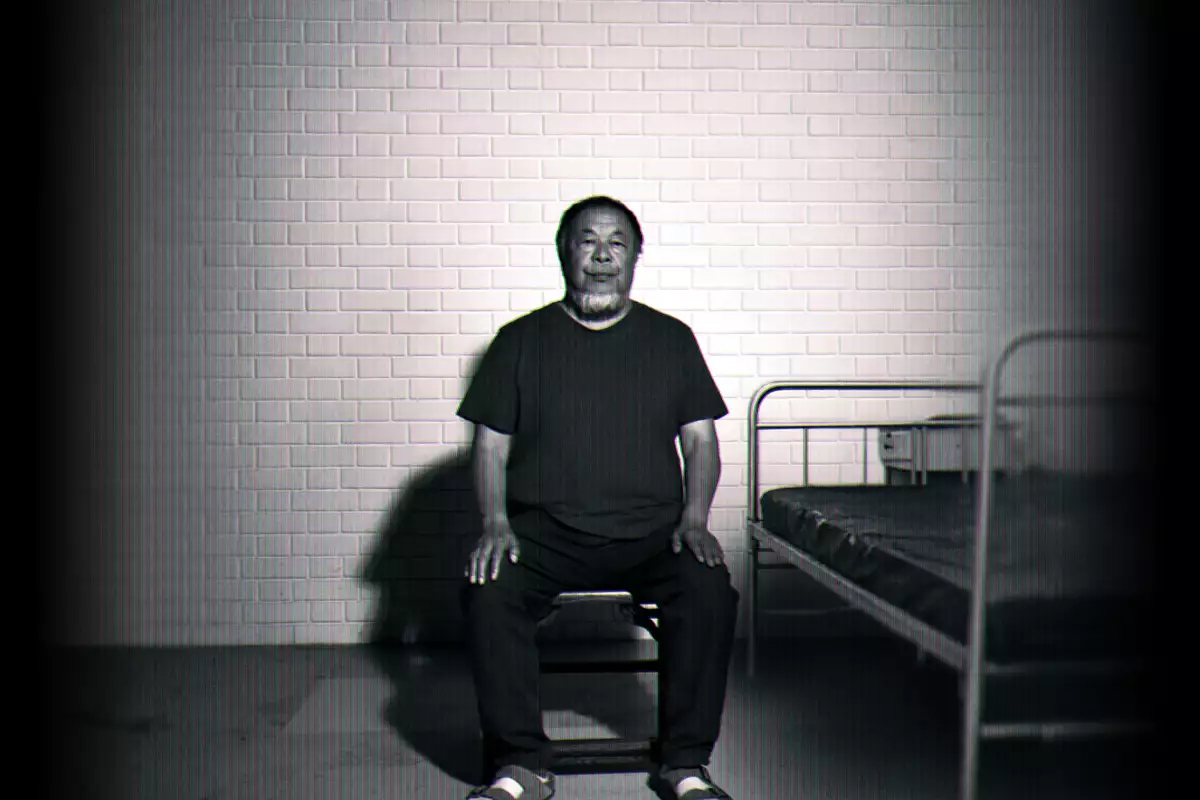
From July 3rd to 4th, 2026, Sewing a Button takes over The Hall at Aviva Studios in Manchester, distilling a pivotal episode from Ai Weiwei’s life into a relentless 24-hour live work. The performance compresses the artist’s 81-day secret detention in China into a continuous cycle of routine, isolation, and psychological strain.
A performance rooted in personal history
Fifteen years after his release, Ai Weiwei returns to the period he was held without charge in a monitored cell. Within Sewing a Button, he occupies a reconstructed version of that space—sleeping, eating, washing, writing, and facing staged interrogations. The work turns private confinement into public testimony, pressing viewers to confront systems of control, coercion, and curtailed freedom.
Presented alongside the exhibition Button Up!, the performance links a personal ordeal to wider histories of politics, exchange, and tension between Britain and China, where lived experience and geopolitics remain tightly interwoven.
The Story Behind Sewing a Button
The title refers to a small gesture from detention: after months without proper clothing repair, a guard finally provided a needle and thread so a missing button could be sewn back on. That modest act became a quiet emblem of dignity inside a regime of restriction.
While Ai Weiwei has previously addressed his imprisonment in works such as S.A.C.R.E.D., 81, and Dumbass, this marks the first live re-enactment of the experience. Over 24 hours, figures including Nihal Arthanayake, Emma Dabiri, Lemn Sissay, and Zing Tsjeng enter staged interrogations, layering the work with shifting voices of authority and inquiry.
Accompanied by an original soundscape from Space Afrika and streamed internationally from Manchester, Sewing a Button stands as one of Ai Weiwei’s most direct engagements with memory, surveillance, and fragile civil liberties. Stark yet deeply human, the performance turns a single cell into a charged space of reflection on power in the present day.
Discover our interview with Ai Weiwei, where he speaks about courage and freedom, the philosophical weight of creation, and how artworks carry memory, meaning, and dissent.