Art has long been a vessel for myth: stories from another realm that runs parallel to our own. Shuo Hao lives within that liminal space, translating it into drawings, paintings, writing, and sculpture. Her works are built on story, rendered with such softness and delicacy they feel capable of breaking a heart. Through her practice of visual storytelling and symbolism painting, she transforms painted objects—like ancient signposts—into playful, almost holographic markers of memory and imagination. In this conversation, she shares her research interests, childhood stories, and the soundtrack currently guiding her world.
hube: You’ve lived in Beijing, Strasbourg, and now Paris. How has each city shaped your visual language, your sense of rhythm, or the emotional tone of your work? Are there particular moments or experiences from each place that continue to resonate in your paintings?
Shuo Hao: Every city has witnessed my process of growth, and my works are the witnesses of that growth. In each period, I’ve created works in different forms, yet they share the same essence, connected to the body, social context, and storytelling.
In Beijing, I wrote, painted watercolors, and made contemporary art using furniture. In Strasbourg, I created contemporary art through jewelry. Since I was always writing stories, I began to paint stories and comics, and to work with pastels and oils. Looking back, these two cities felt like my laboratories. Now, in Paris, I paint and write every day. Gradually, I began collaborating with galleries while continuing to write and paint in oil, and now I’ve started sculpting. Perhaps years from now, when I look back, Paris too will have been my artistic laboratory.
h: Your images often oscillate between tenderness and violence, softness in form yet sharpness in emotion. How do you negotiate that tension, and what does it reveal about your relationship to human experience or memory?
SH: In recent years, I’ve been studying ancient Chinese divination methods—ways to reveal a person’s deepest inner truth. These practices are ancient forms of human experience that echo what Jung called the collective unconscious. Through them, I discovered the roots of the two extremes within my own character: tenderness and violence. These once caused me great pain when I was younger. Now that I understand their origins, I am learning to embrace them. They are like my left and right hands: only by accepting both can I allow energy to flow freely.
h: Animals appear repeatedly in your work, sometimes intertwined with human forms. What do they signify, and how do they transform or challenge the narrative of the human figure?
SH: They symbolize emotion, instinct, and mythology, but they also guard the most authentic world within me. They were once human too—as seen in both Greek mythology and Chinese ideas of reincarnation. For example, Actaeon transformed into a deer, and Nüwa, who created heaven and earth, was half serpent.
I believe all animals are like humans; they simply have different ways of expressing themselves. During a reading session at one of my exhibitions, I once said spontaneously: “I feel as if I’m made of animals—my heart is a rabbit, my liver a swan, and my blood a snake.”
h: You’ve painted on folding screens, vanities, and other unconventional surfaces. How do the physical properties of an object inform the conceptual framework of your work? Can the surface itself become a co-creator in the process?
SH: Since childhood, I’ve loved old things. I used to collect objects from my grandparents’ home and write or draw in old notebooks. My mother once said she sometimes felt I was older than she was.
Now, most of my work is created on old objects because I truly love them. My greatest pleasure is visiting flea markets and auctions to find items that feel familiar to me. My studio is filled with old pieces—from expensive 18th-century woodwork to 20th-century objects worth perhaps only one euro.
Because I love them so much, I often don’t know what to do with them, so I paint over them with things I love even more: mythological stories infused with personal experience. In that moment, the object and I become one.
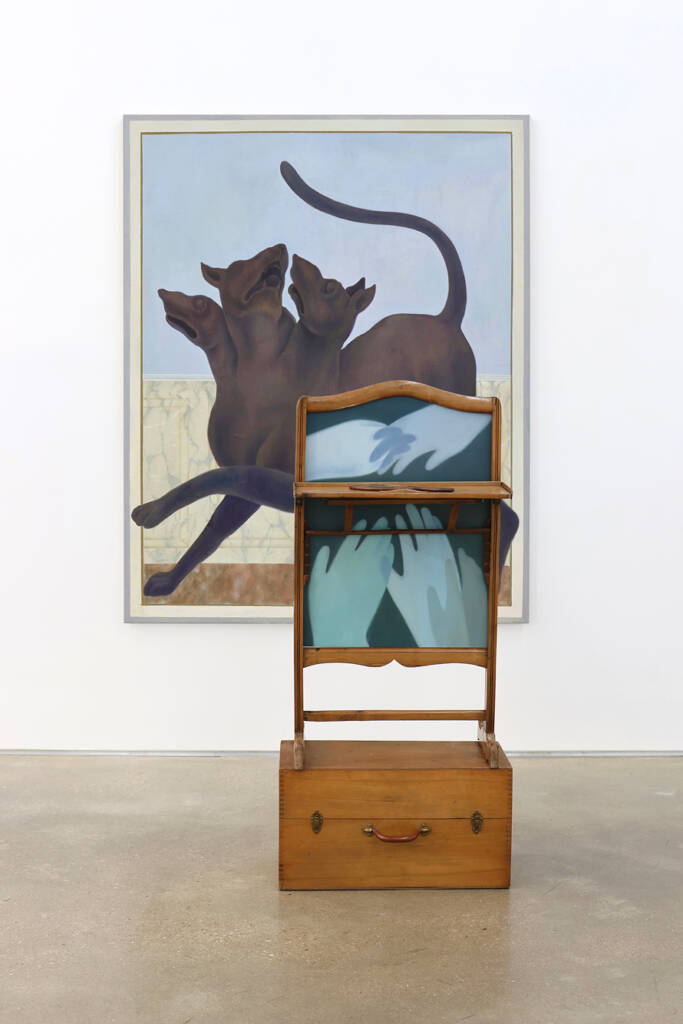
Derouillon, Cerbère + Protection, 2025
Courtesy of YOUNA VIRUS
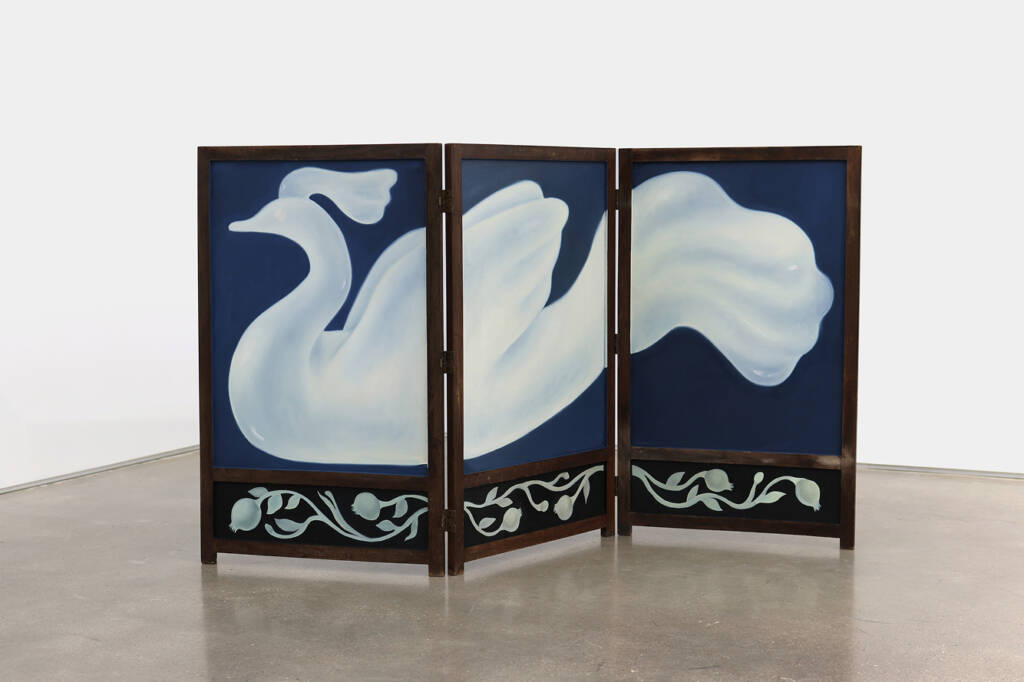
Derouillon, Offrande e_ternelle, 2025
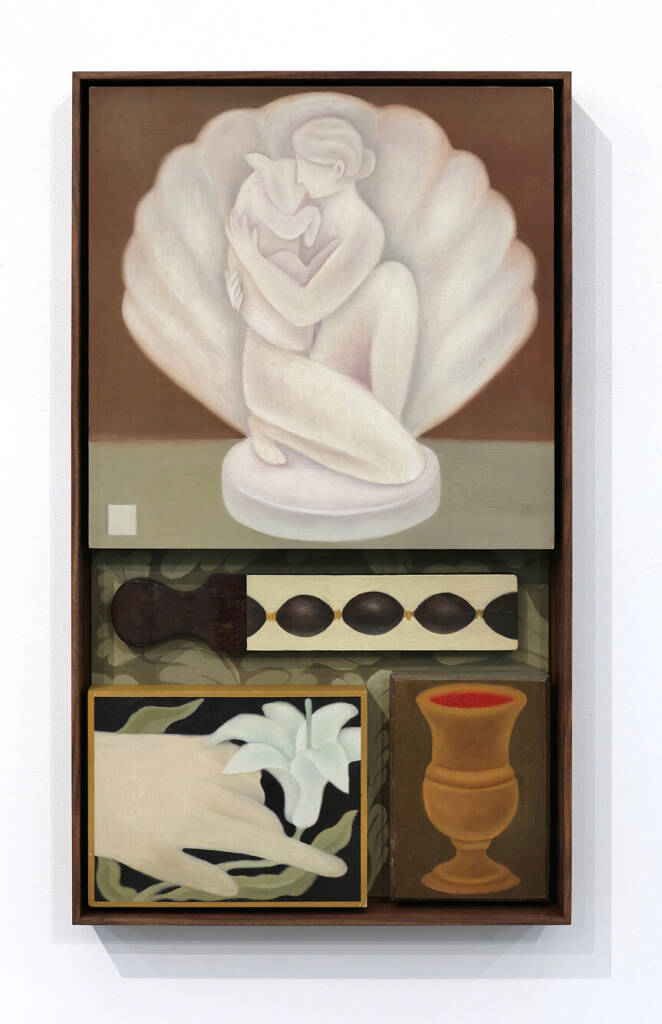
Derouillon, Assemblage 02
Courtesy of YOUNA VIRUS