
Photography by FRANCESCO RUSSO
Catharsis Metanoia
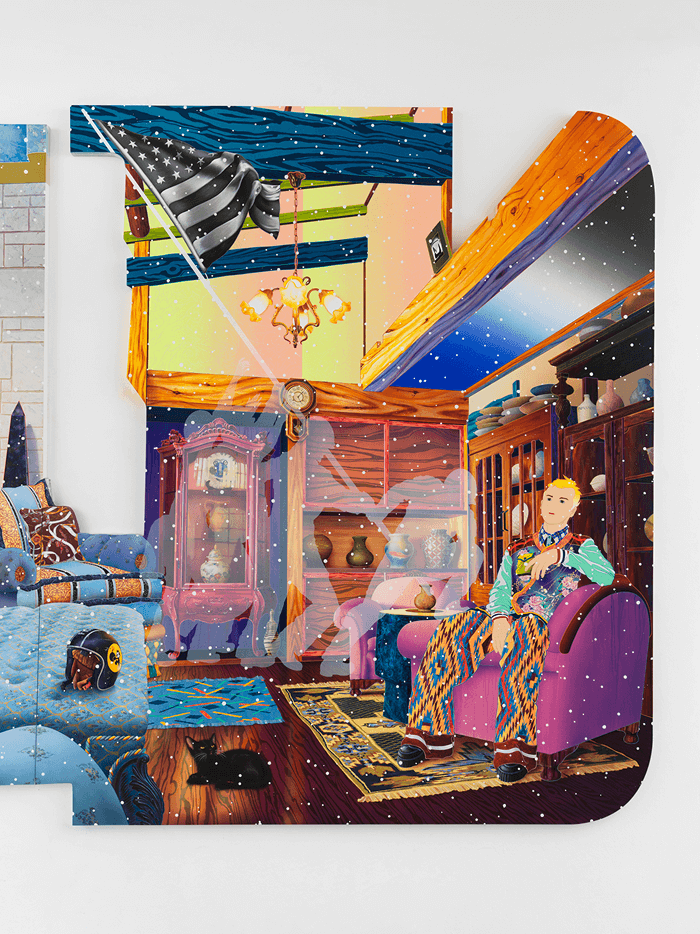
Catharsis Metanoia
Photography by FRANCESCO RUSSO
Photography by FRANCESCO RUSSO
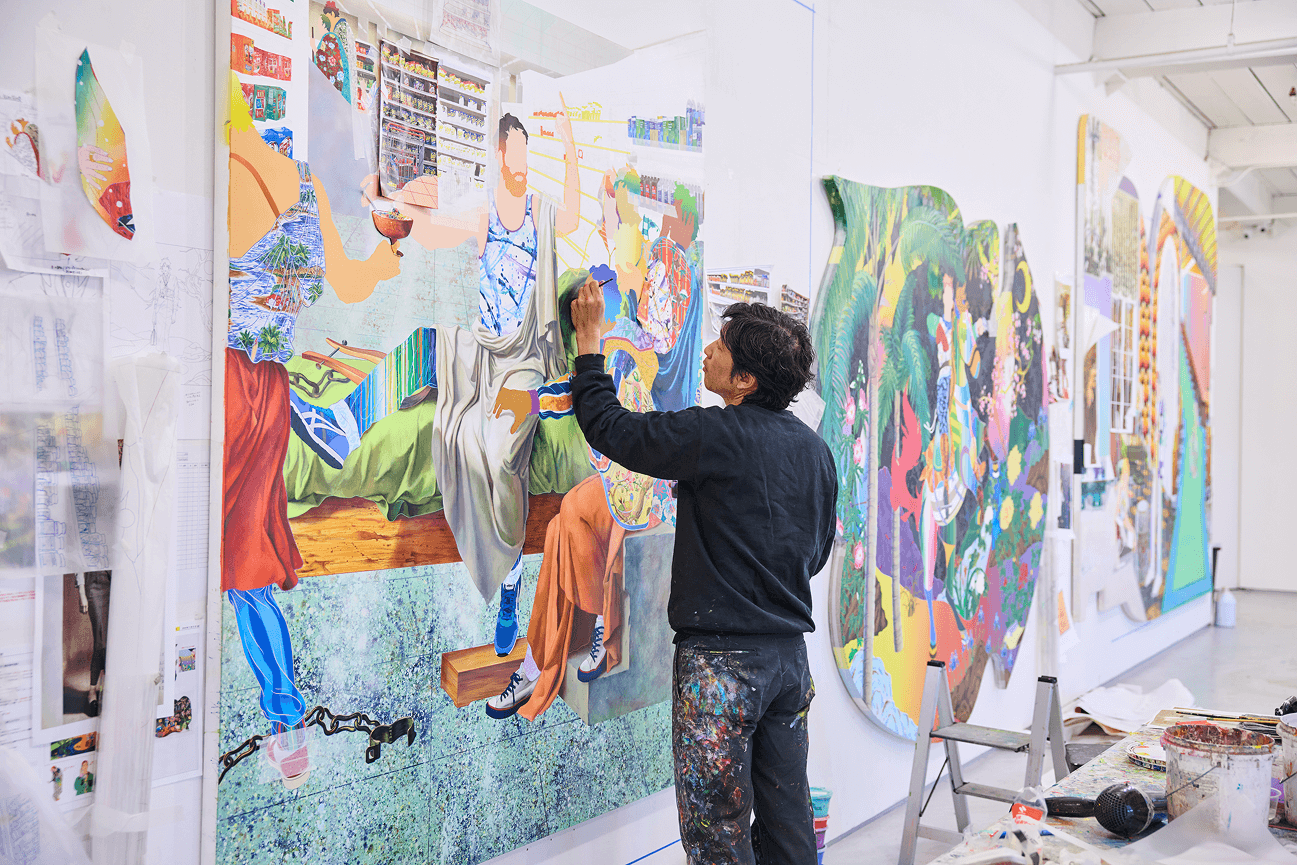
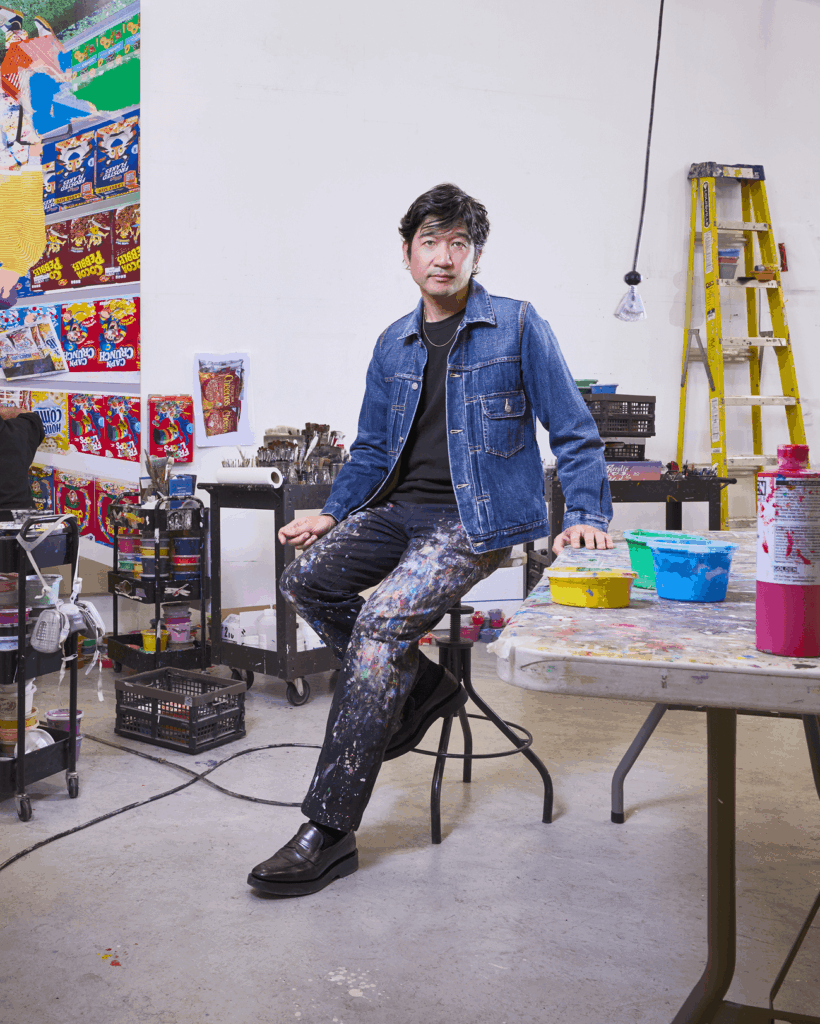
The image, as we understand it, no longer succeeds but precedes experience, entering our memory before we even have a narrative for it. Once trusted to capture time, the picture has come to serve as a message, carrying fragments of self, desire, and belief, gradually unmooring itself from its origins. Meaning metamorphoses, identity becomes provisional, and myth enters not as history or inheritance, but as a modern construct. The individual in the image has long held significance in shaping our social identity, proving essential to our life stories, and of the assurance of the earth standing still for long enough to allow us to recognise our place upon it. Having originally spoken in 2024, when Japanese artist Tomokazu Matsuyama was participating in the 60th edition of the Venice Biennale, his interview appears even more poignant than ever, as we lead our lives by social media. Looking at Matsuyama’s paintings he allows everything to enter into his sphere of thinking — a world that is visually decorative while being intentionally destabilising at the same time. The eternally youthful punctuate his paintings like characters performing on a stage. Positioned within touching distance of one another, Matsuyama’s figures nonetheless appear forlorn — more isolated than engaged with their surroundings. They occupy space physically yet remain emotionally and psychologically disconnected from it. This estrangement lies at the heart of his vision. In his time, the Polish sociologist and philosopher Zygmunt Bauman spoke of a “liquid modern life,” in which there are “no permanent bonds,” and any we form must be tied loosely enough to be undone and reconfigured as circumstances inevitably change. That fluidity — the fusion of past and present — is central to how Matsuyama sees the world. It is also key to understanding the exhibition’s title.
“Mythologiques,” he explains, “draws inspiration from Claude Lévi-Strauss’s structuralist ideas, especially his exploration of myths as frameworks for understanding cultural narratives. By invoking this title, I wanted to reflect on the layering of identity in our globalised era, where cultural symbols and histories intersect fluidly.” Matsuyama creates worlds that are anything but flat. His motifs offer evidence of the postmodern condition — one in which we see and feel the present through future technologies, existing as much within the digital realm as within physical reality.
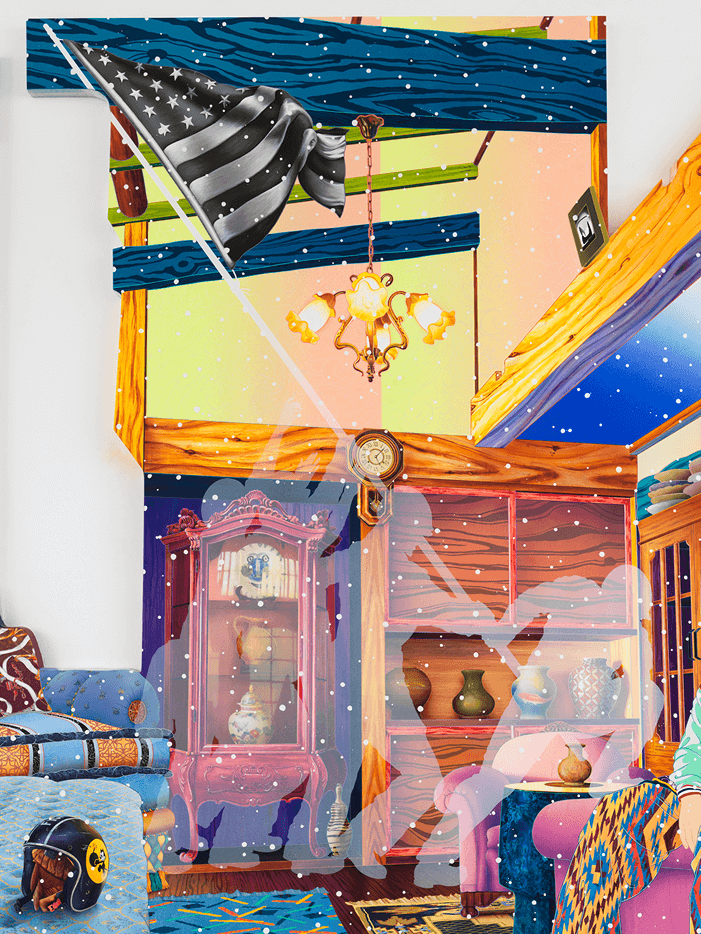
Uncertainty, and the instability of truth itself, is essential to how we should read these paintings. There is none of life’s dirt colouring the final image. Instead, they possess a cartoon-like cleanliness in which everything becomes decorative. The shadow cast by the American flag being hoisted on Mount Suribachi in Catharsis Metanoia — reproduced from Joe Rosenthal’s iconic wartime photograph — is rendered as surface pattern. A football helmet rests on a sofa table like a fake trophy, illustrating how our lives are increasingly shaped by illusion, misinformation, and hollow ambition. Here, decoration carries meaning. Nowhere is this more pronounced than in Passage Immortalitas (2024), where Matsuyama draws from an Old Master depiction of the Annunciation, recasting its figures with the stylised youthfulness of a K-pop boy band. A discarded pizza box rests on the table before them. The scene overflows with extravagant detail, its surface intentionally unsettled by a snowfall of uncertainty. We are left to ask: Is anything we see real?
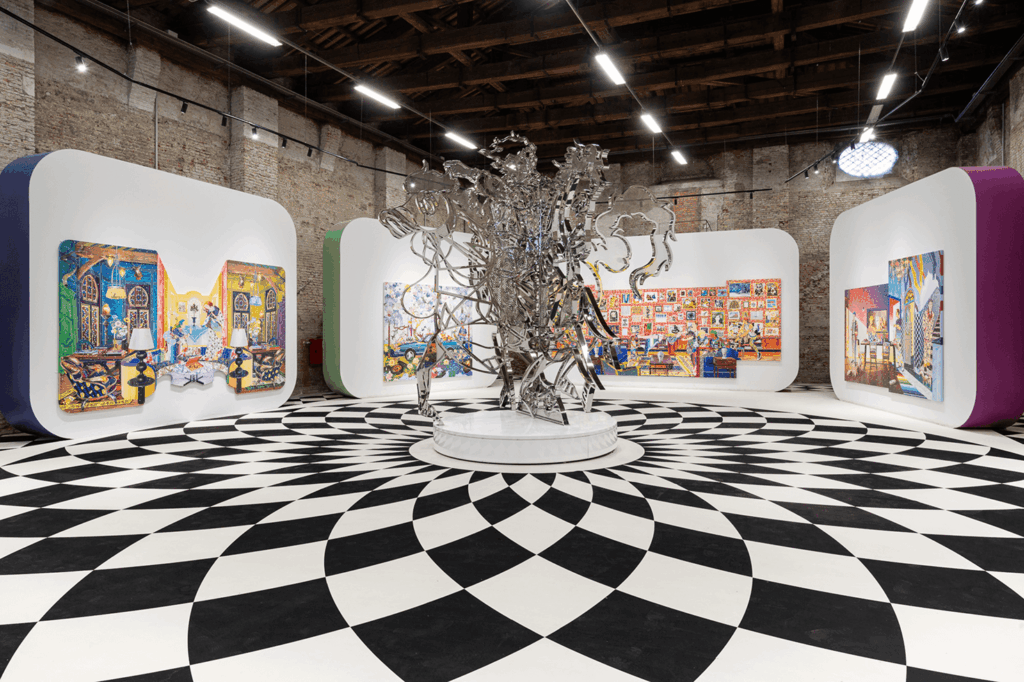
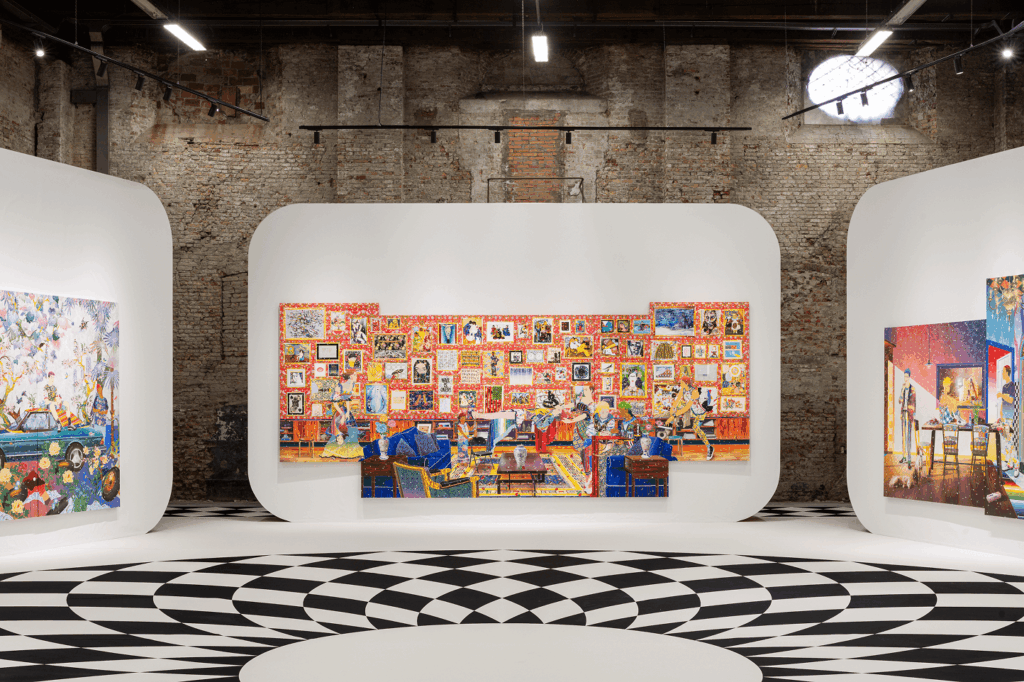
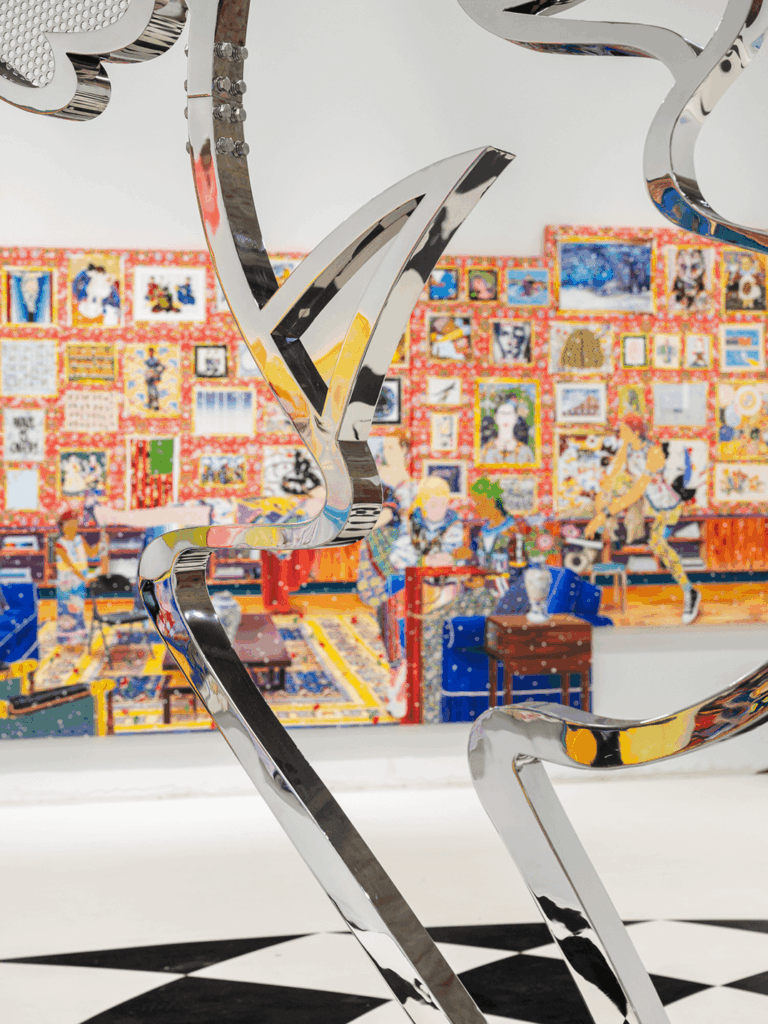
Installed against the coloured walls of a semi-circular set — centred by a manga-styled mirrored sculpture — Matsuyama’s works unfold as montages. Multiple canvases are configured to suggest narrative, yet feel perpetually reconfigurable: furnishings could move forward, figures could recede. What we encounter resembles Instagram imagery, where identities merge and meanings become simultaneously curated and confused. Like commercials for contemporary living, these are ‘wallpaper’ paintings — referencing immersion without offering the real. As Matsuyama himself explains, “the ‘real’ holds significance in my work but often serves only as a starting point rather than the focus. I incorporate real-world symbols, cultural references, and familiar imagery, layering them in ways that allow new meanings to emerge, blurring the line between what’s ‘fake’ and what’s perceived as reality.” In the modern condition, surface and falsehood have fused so completely that seeking truth can feel indistinguishable from performing illusion.
To come, Tomokazu is curating Soft Reins (6th February – 22nd March, 2026), a group exhibition at Acquavella Galleries’ Palm Beach location. The exhibition explores the enduring significance of the horse as a powerful symbol and artistic muse, highlighting how the animal has inspired art, mythology, and storytelling throughout art history. He will also show a work for Midnight Moment in Times Square in April; that work will be shown on over 92 digital displays spanning 41st to 49th Streets in Manhattan, New York.
Rajesh Punj: Having returned from Venice some days ago, I wanted to begin by asking about the exhibition title and its meaning.
Tomokazu Matsuyama: The title Mythologiques draws inspiration from Claude Lévi-Strauss’s structuralist ideas, especially his exploration of myths as frameworks for understanding cultural narratives. By invoking this title, I wanted to reflect on the layering of identity in our globalised era, where cultural symbols and histories intersect fluidly. The exhibition creates a space for these narratives to coexist, inviting viewers to explore identity as something that evolves through constant dialogue and reinterpretation.
You, One Me Erase
RP: How important is painting to you as a form of expression?
TM: Painting is essential to my practice because it allows me to explore and layer diverse cultural narratives in a deeply tactile way. Through it, I can blend longstanding cultural heritage with modern influences — from traditional kimono patterns to American consumer goods. Painting enables me to capture the intersections of personal and collective experience, weaving symbolism and detail into something both immediate and reflective.
RP: Can you explain your postmodern approach — the multiple meanings and sources of imagery?
TM: My approach involves layering diverse symbols from different cultures, histories, and aspects of contemporary life — traditional Japanese textile patterns alongside branded packaging, for example. These intersections allow familiar motifs, like cherry blossoms or William Morris patterns, to collide with urban advertisements or food logos from American corporate culture. This reflects how narratives overlap and evolve in our interconnected world.
RP: How important is the ‘real’ to what you represent?
TM: The real is important, but it often functions as a starting point rather than the destination. I layer real-world symbols in ways that allow new meanings to emerge, blurring the boundary between what is fake and what is perceived as real. This reflects how identity is continuously reshaped in a virtual world where fake and reality increasingly collapse into one another.
RP: I see as much of the Old Masters in your work as the contemporary. How do these references come together visually?
TM: I draw from Renaissance painters such as Tintoretto and Botticelli, alongside pop art and consumer culture — Starburst wrappers, street carts, advertising. By uniting these contrasts, I aim to create a dialogue between past and present, crafting compositions that resonate now while remaining open to future interpretation.
RP: The perspective in your paintings often appears flat. Is that intentional?
TM: Yes. While the surface may appear one-dimensional, this allows me to layer complex cultural references within a unified space. The apparent flatness reflects the chaos of today’s visual environment, enabling multiple narratives to coexist and interact beneath the surface.
RP: Can you explain the white dots that cover much of the canvases?
TM: The white dots hint at the fictional nature of these scenes. They are inspired by the concept of setsugekka — snow, moon, and flowers — representing beauty’s transience. They evoke a space between the spiritual and the physical, life and death. On another level, their application mirrors the gestural language of Abstract Expressionism, referencing artists like Jackson Pollock and Sam Francis.

Photography by FRANCESCO RUSSO

Photography by FRANCESCO RUSSO

Bring You Home Stratus, detail

Bring You Home Stratus, detail

Photography by FRANCESCO RUSSO

Photography by FRANCESCO RUSSO

Patterns Erase When Orange Is The Sky, detail

Patterns Erase When Orange Is The Sky, detail

Photography by FRANCESCO RUSSO

Photography by FRANCESCO RUSSO
RP: The paintings are arranged semi-circularly. Is there a narrative linking them?
TM: There is no fixed narrative. Each painting acts as a mirror reflecting aspects of my inner world. They can be experienced independently, yet collectively form a dreamlike environment that invites personal reflection.
RP: When you introduce so many elements, does everything matter equally?
TM: Every element carries meaning, but some are given greater prominence. I think of the compositions as tapestries — certain symbols act as anchors, while surrounding details invite exploration. This balance allows clarity and complexity to coexist.
RP: How influential are Japanese approaches to painting in your work?
TM: They are foundational. Japanese painting’s emphasis on balance, negative space, and detail shapes my practice. At the same time, living in New York has introduced global influences — street culture, pop imagery — which I blend with those traditions.
RP: Are the titles intended to guide interpretation?
TM: Titles emerge intuitively. I think of them like sampling — pulling words from music, song titles, and pop culture. They aren’t meant to dictate meaning, but to add another layer of suggestion.
RP: There is a sense of celebrity to the figures. Are they meant to relate to one another?
TM: The figures carry an aura of celebrity, but their expressions remain ambiguous. They exist together without necessarily being aware of one another. Drawn from advertisements and online imagery, their original function fades, leaving only posture and expression — inviting viewers to interpret their connections.
RP: How do you decide on composition and canvas configuration?
TM: I’m interested in capturing fleeting moments of contemporary life — snapshots filled with cultural remnants. Like historical paintings that later became symbols of their era, I hope these works may one day reflect our time. The canvas shapes reference traditional Japanese ceramics, linking modern imagery to classical form.
RP: Colour plays a strong role in creating space. How do you approach it?
TM: Colour creates zones within each painting, guiding how viewers move through the image. Bold tones may signal modernity, while softer hues suggest reflection or nostalgia. Colour allows multiple emotional and cultural spaces to coexist.
RP: Despite the open-plan settings, the figures feel isolated. Was that intentional?
TM: Yes. That isolation reflects fragmented identity. We inhabit shared spaces while remaining deeply personal, often solitary, in our experience — a paradox central to modern life.
RP: The faces sometimes seem to both belong and not belong. Are you evoking a contemporary sense of loss and loneliness?
TM: Exactly. The faces exist between belonging and displacement, mirroring how people navigate multiple identities today. They feel familiar yet distant, reflecting our fragmented emotional landscape.
RP: Can you explain the central sculpture?
TM: Black Hole Hunter reinterprets historic equestrian statues, traditionally symbols of power. As these monuments are reconsidered today, the sculpture reframes authority through minority perspectives. Venice felt like the ideal site to question how power, representation, and legacy evolve.
RP: How important is manga imagery to you?
TM: Manga isn’t a primary influence, but it’s part of everyday visual culture. It naturally enters the work alongside other contemporary references.
RP: Do you see the works as collages?
TM: I see them more as tapestries — organic layers where symbols, objects, and histories coexist and interact, reflecting contemporary identity’s overlapping nature.
RP: What do you want audiences to feel?
TM: I hope they see the work as more than decorative — as layered narratives that invite reflection on identity, culture, and connection. Familiarity mixed with curiosity.
RP: Is the modern experience essentially one of being alone?
TM: Can we even resist it? In a world that is deeply connected yet isolating, solitude may simply be part of the condition.
RP: What are you reading right now?
TM: I’m following the American election on television — it’s election day.

Photography by FRANCESCO RUSSO

By And By Daylight

Catharsis Metanoia

You, One Me Erase

Photography by FRANCESCO RUSSO

Patterns Erase When Orange Is The Sky

Bring You Home Stratus

Bring You Home Stratus
Words: RAJESH PUNJ
