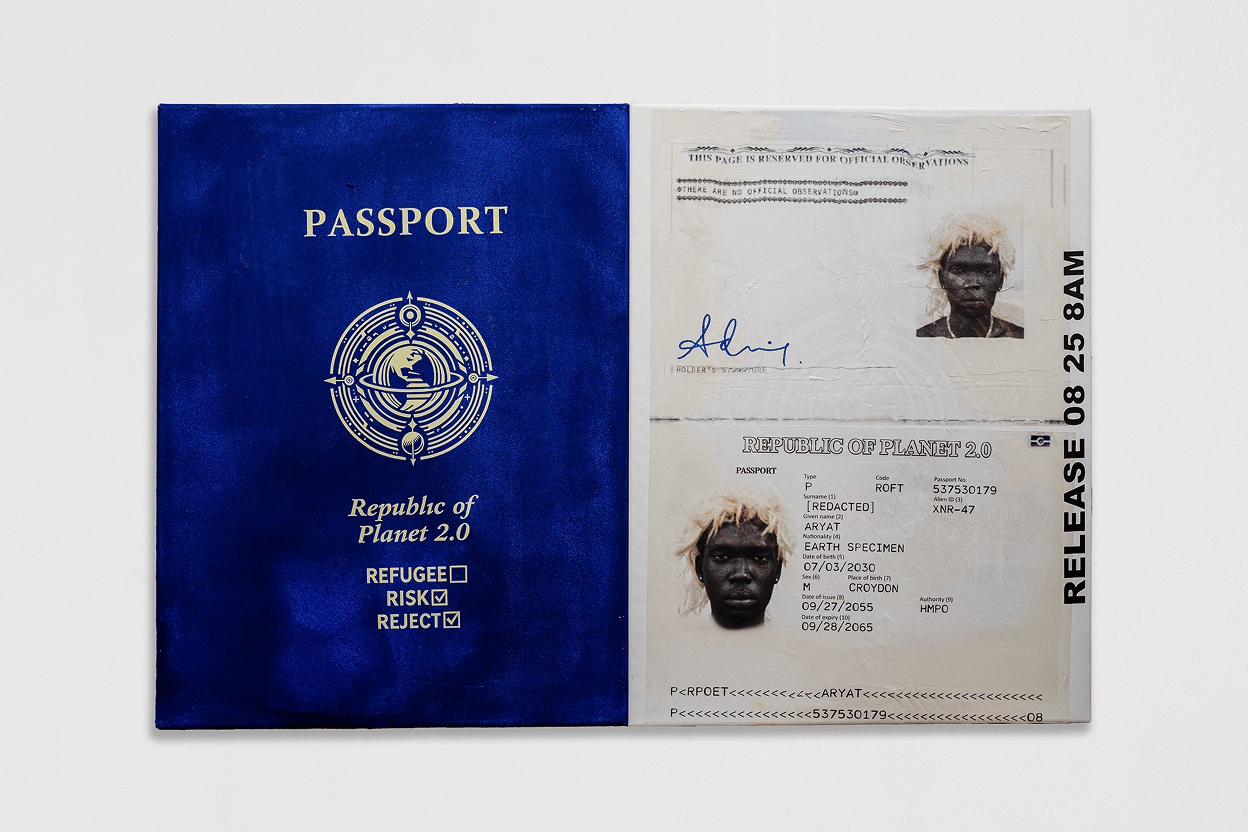
SOLDIER, 'Stamped Out of Existence [PL ANET 2.0]'

Revealing softly: Soldier on power, camouflage, and imagining the future

Leonard Iheagwam, known as Soldier, works from lived experience rather than fixed categories. Born in Lagos and now based in London, his practice moves across painting, sculpture, fashion, skate culture, and performance, drawing from personal history, collective memory, and speculative futures. Camouflage, both as pattern and metaphor, has become a form of language in his work, pointing to systems of power, protection, and invisibility that shape everyday life.

For Future Tense, an online exhibition curated by Soldier for MyMA, the artist shifts from making to gathering. Bringing together voices from different geographies and disciplines, the exhibition presents a fragmented, emotional, and shared vision of the future. It also marks a new chapter for MyMA, which for the first time places curatorial agency in the hands of an artist.

In this conversation, Soldier reflects on authority, the tension between authenticity and systems, the role of community, and what it means to imagine a future without pretending to have a single answer.

hube: Much of your work interrogates authority, exclusion, and inherited structures—military, religious, cultural. What drives that impulse to question power, and has its meaning shifted as you’ve grown as an artist?

Soldier: I would say that what drives this impulse is my situation and my understanding that, in life and in this world, there are hierarchies. I was born into a lower-class family in a country without the visa structures that would allow me to travel the world. The effects of colonialism and war have opened my eyes to these power plays and hierarchies, so my lived experiences inform my artistic research.

This view hasn’t necessarily changed, but the older I get, the more aware I become of the power of race, war, family, and relationships, and how all of these play into my work.

h: How do you see the role of the artist in society: observer, critic, or agent of change?

S: I think the role of artists in society comes from all three.

I would say artists act as historians—the work we make is almost a reflection of the current time and moment. Its beauty and aesthetic pleasure are important, but it also shows where that artist is in life. That may be a particular place, culture, or the systems they’re in, and some artists use that reflection as a way to critique culture. You can look to art to see the times and how a particular cultural moment existed.

That’s why I made the body of work Black Star, not necessarily as futurism, but as a vehicle to speculate on the future. Art, for me personally, is both a reflection and a vehicle that can take you from the past and present and bring you into the future. In the same way, art can be used to reflect the timelines we’re living in now, while also looking toward the future.

Art can stir something in other people, create movement, and create change. That’s why I’m excited about this group show with MyMA. I feel like the show encompasses all three things. It’s a critique, an observation, and an agent of change for what the future could hold.
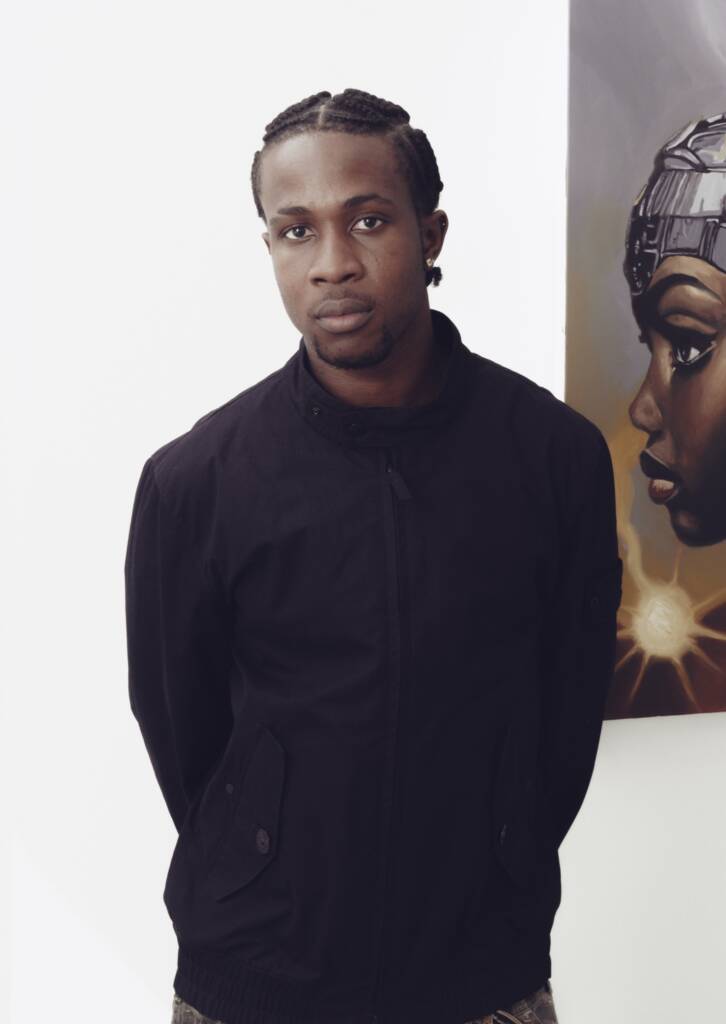
Leonard Iheagwam
artist Soldier
speculative futures
collective memory
SOLDIER X SALOMON
Photography by JIVAN WEST
Leonard Iheagwam
artist Soldier
speculative futures
collective memory
SOLDIER
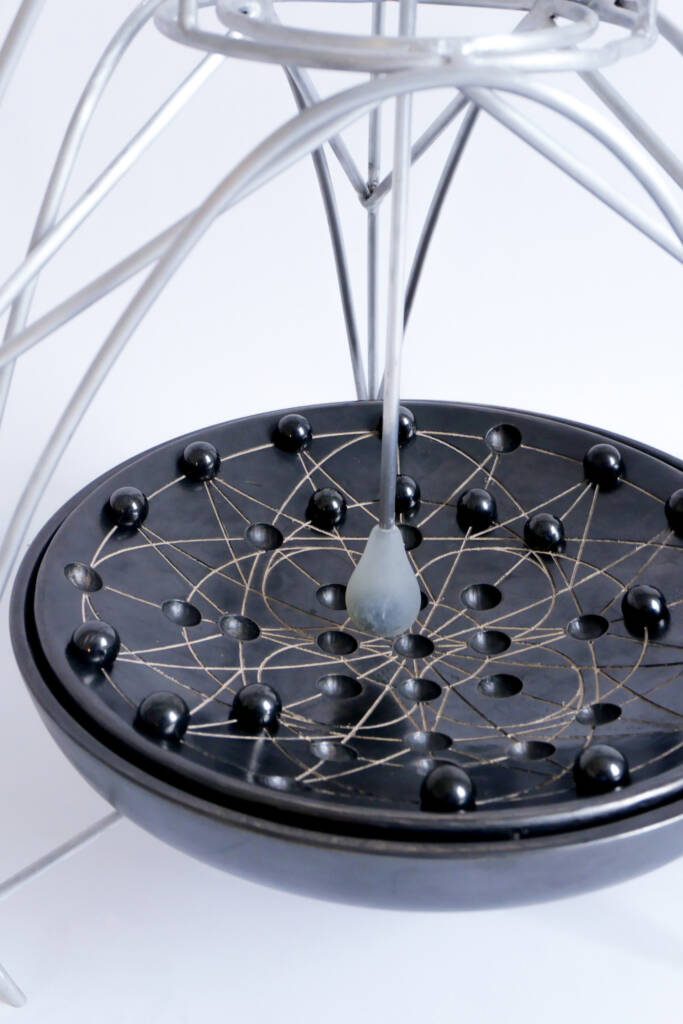
Who would I become in an alternate universe, Panchaphalasom
Leonard Iheagwam
artist Soldier
speculative futures
collective memory
SOLDIER
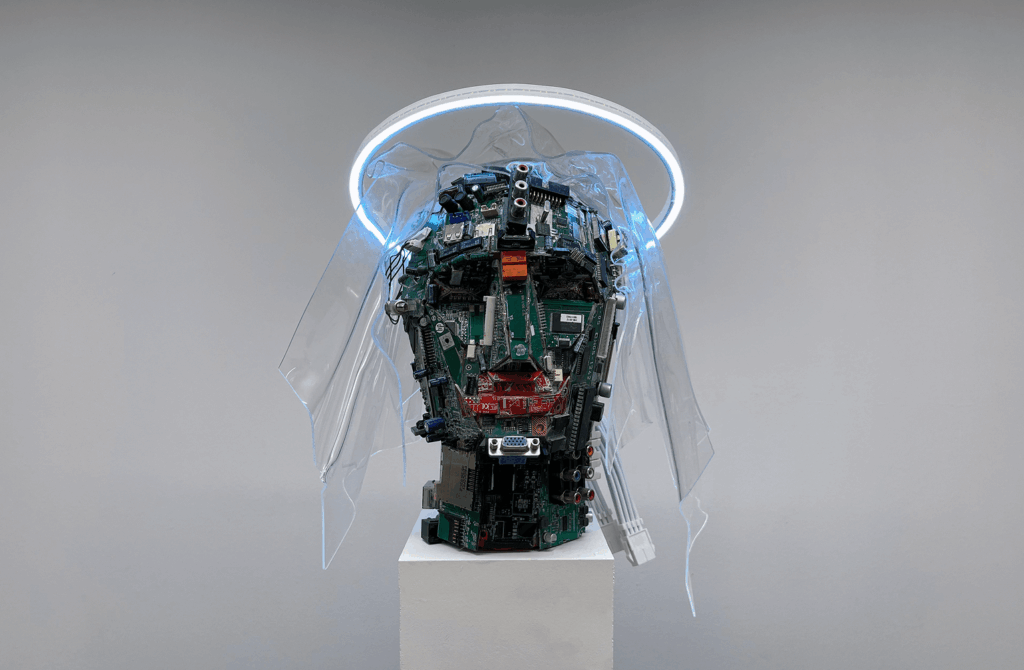
Who would I become in an alternate universe, Panchaphalasom
Leonard Iheagwam
artist Soldier
speculative futures
collective memory
SOLDIER
Virgin Mary, 2022
Leonard Iheagwam
artist Soldier
speculative futures
collective memory
Courtesy of SOLDIER
Leonard Iheagwam
artist Soldier
speculative futures
collective memory
Courtesy of SOLDIER
Leonard Iheagwam
artist Soldier
speculative futures
collective memory
SOLDIER
Garden Ruin
Leonard Iheagwam
artist Soldier
speculative futures
collective memory
SOLDIER
Guardian Lion 2 
Leonard Iheagwam
artist Soldier
speculative futures
collective memory
SOLDIER
Time Being, 2025
Leonard Iheagwam
artist Soldier
speculative futures
collective memory
SOLDIER
Time Being, 2025
Leonard Iheagwam
artist Soldier
speculative futures
collective memory
SOLDIER
填充物 Stuffing

h: You’ve often said that lived experience is central to your work. Now, as your audience and platform expand, how do you define authenticity? Has your relationship with it changed?

S: My favourite quote is, “Give to Caesar what belongs to Caesar, and give to God what belongs to God.” For me, it speaks to the balance between the world and the divine. Being authentic is being divine, but the systems in which we show our work are just that: systems.

I define authenticity as creative flow. The things that feel more systematic belong to the system. Creativity itself is authentic, but the system is different; that’s where you need to get a job, promote yourself, and market yourself. I feel I’m always authentic in my work, but when it comes to marketing, you have to play the game, and some people might see that as less authentic.

h: Camouflage recurs in your practice, both visually and symbolically. How has your understanding of its meaning evolved?

S: When I first started, I used camouflage almost to practice form, shape, and colour, and I was highly influenced by my environment. I had lots of run-ins with the army and police in Nigeria, and I honed in on that from a young age.

When I started going deeper into it, I realised it goes beyond that and into culture and psychology. You can look beyond the pattern to a system of behaviour—a pattern used to hide intentions or for protection. It made me realise that a lot of humans put up these camouflage walls to hide their intentions, and I got enamoured by that. One of my favourite quotes, “to reveal yourself softly,” highlights that, for you to get inside systems, you have to start by deciphering the camouflage or systems that people hide behind.

My job is to break down what it means to reveal and how people hide.

h: Can you recall the first time you realized art could be more than an escape—that it could actually guide your life or offer a path forward?

S: I think it was when I was around 10. I grew up in the church, as my father is a reverend, and there was an art competition where they asked the kids to draw an image of the nativity. I drew the image, and when I submitted it, I was disqualified because they thought it was too good and said my dad must have drawn it.

It opened my eyes to the fact that I was good at observing and putting those observations onto a page. It was the first time I realised certain things. Eventually, by going to exhibitions and understanding the history of art, it made me realise that art is a tool for keeping time, for making your ideas, loved ones, or viewpoints immortal, and for figuring out how the world works.

h: Future Tense resists the notion of the future as spectacle. How do you personally feel or imagine the future—not as an image, but as an emotional landscape?

S: Confusing.

There are so many things happening right now. While some things are beautiful, others are quite dystopian and confusing. I think many people around my age are excited about the future, but also filled with dread.

h: This is the first time MyMA has invited an artist to curate an exhibition. How does curating relate to your own practice?

S: I think it’s both. It challenges my beliefs, as you see other artists’ own takes on what the future is. That’s challenging, as it opens up the notion that your viewpoint isn’t the same as others, but it’s also such a beautiful thing to perceive.

My practice is based on gathering knowledge, and it’s so interesting to see the work of so many people, soak it all up, and almost use it as a way of gathering knowledge in its own right. It means a lot to be the first artist that MyMA brought on board for this project, as it is also one of the first things I have curated.

h: The exhibition brings together voices from multiple geographies and disciplines. What kind of dialogue or tension did you hope would emerge?

S: I think it’s fascinating that so many people can see how others perceive the future. I was inspired by music, books, and Black culture to create my work, so I love seeing people from other nations contribute their own vision of the future. I don’t think the future is based on one person’s perspective. It reflects everyone’s points of view and challenges the notion of what the present is.

h: Skate culture, fashion, and online communities often feel more immediate and accessible than traditional art institutions. What lessons could the art world learn from these ecosystems?

S: It’s a very inclusive process. The art world has often seemed very exclusive to me, but I believe that art can mean many different things and that many people should be involved in creating dialogue.

One of my first introductions to the art world in a Westernised sense was through skateboarding. I came across skateboards featuring the work of different artists. I had a skateboard with Hieronymus Bosch’s The Garden of Earthly Delights on it, and just having it in my house for so long drew me closer to art.

The same with fashion—you see many artists intersecting with clothing, like what Dior did last season, referencing Basquiat on their runway. These are some of the most obvious ways they interact, and my purpose, like my predecessors, is to break down these doors for others.

h: Right now, who do you feel you’re making work for—the entire art world or your own community?

S: Myself. I have a lot of respect for the art world as an institution, and I’m grateful for museums and galleries, as well as for the fact that many artists can make a living from them. However, I’m also very aware of community and the times we live in. I’m quite insular and care deeply about certain things, so I’m serving those three masters: the art world, the community, and myself.

h: In a time of uncertainty, what gives you hope about the future?

S: People.

h: Thinking back to the sixteen-year-old version of yourself who left home, what do you imagine would surprise him the most about who you’ve become today?

S: The fact that I’m doing the exact same thing I was doing at 5 years old.

Leonard Iheagwam
artist Soldier
speculative futures
collective memory
SOLDIER
Whats a dragon to a dragon, 2024
Leonard Iheagwam
artist Soldier
speculative futures
collective memory
SOLDIER
What Could Be Panchaphalasom
Leonard Iheagwam
artist Soldier
speculative futures
collective memory
SOLDIER
Contours of a Leaking Body, 2025
Leonard Iheagwam
artist Soldier
speculative futures
collective memory
SOLDIER
Trash Cowgirl, 2022
Leonard Iheagwam
artist Soldier
speculative futures
collective memory
SOLDIER
MOUTHLESS, 2024
Leonard Iheagwam
artist Soldier
speculative futures
collective memory
SOLDIER
MOUTHLESS, 2024

ISSUE 7

The new edition is here